
National Award-winning,
Family-run Newspaper
Family-run Newspaper
It’s been another wonderful week, weather-wise, as September continues to bring us warm sunny days, cool evenings and mornings and clear skies. However, for our rivers and streams, rainfall is …
This item is available in full to subscribers.
Please log in to continue |
It’s been another wonderful week, weather-wise, as September continues to bring us warm sunny days, cool evenings and mornings and clear skies. However, for our rivers and streams, rainfall is sorely needed.
The Beaverkill at Cooks Falls registered a paltry 62 cubic feet per second, as compared to the mean average flow of 252 cfs based on 112 years of record-keeping! Fortunately water temperatures have been favorable for the trout, as long as they can find respite in the deeper pools and runs.
Angling success was reported by several fishing friends this week. Ed Walsh was fishing on the East Branch and did well. He brought along a new rod, a beautiful two-piece, nine-foot rod for a 4-5 weight line, with a Mike Canazon taper, made especially for Ed by his friend Munsey Wheby, and Ed decided to use it for the first time on this outing. Noticing quite a few fish rising from about 5 - 6:00 pm, he chose a size #14 dry fly tied for him by Mark Sturtevant, that he calls a “Cripple Emerger.” Mark tied the fly with a dyed Turkey Biot body (Biot fibers are the long tapered fibers from the primary feather of a turkey that are used to create realistic-looking segmented fly bodies) and Cul-de-Canard (CDC) emerging wing. Ed caught a nice brown trout and was satisfied by the “group effort,” relating to his friends their part in his success!
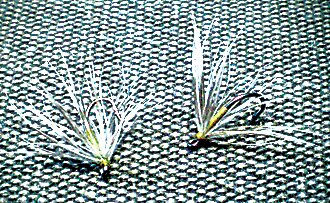
Tom Mason reported that Jean Brandin, fishing the Beaverkill one rainy day last week, had productive fishing using a fly called “La Peute,” a French idiom meaning “Ugly.”
The name refers to its non-specific, impressionistic appearance, tied to entice the fish rather than to imitate a particular insect. La Peute is a pattern that was made popular by the famous French fly-fisherman Henri Bresson (1925 - 2011)
Tom tied up a few and shared his pattern for the La Peute:
Hook: Syl Nemes raised eye soft hackle wet fly size 15.
Silk: Pearsalls gossamer yellow.
Body: Yellow silk.
Hackle: Hen mallard breast.
The West Branch of the Delaware has been a bit discolored lately, as Cannonsville Reservoir is releasing water into the West Branch of the Delaware to satisfy the minimum flow of water at Montague, NJ, called for by the Delaware RiverMaster. The reservoir is also in the middle of its “fall overturn,” which explains the muddy appearance of the West Branch.
However, Christina Mueller and Mark Williams were fishing on the lower West Branch of the Delaware, and reported great fishing over the past three days. They saw good numbers of fish rising each evening. Christina caught several trout on a tiny Blue-Winged Olive Emerger size #22 and a size #22 Dorothea (Pale Evening Dun), and Mark also did well using the #22 Pale Evening Dun.
Fall overturn happens in many lakes and reservoirs, and is a natural occurrence caused by the seasonal change in temperature. In the summer, the water’s surface is heated by the sun, while the deepest waters remain cold. The reservoir stratifies, or forms layers according to the temperature. The top warm layer is called the Epilimnion and contains the most oxygen; the bottom cold layer is oxygen-poor, and is called the Hypolimnion, and the central layer is the Thermocline. Many reservoir fishermen use “fish finders” to successfully locate the trout under the water’s surface and improve their fishing success.
When the colder weather and approaching fall arrives, the reservoir’s layers actually mix - the surface layer becomes cooler and more dense and begins to sink, displacing the warmer and less-dense water below it. The “fall overturn” is not actually turning over of the water but rather mixing of the water, and along with the wind, blends the now-colder upper layer of water with the warmer below-layer of water. Also mixed in are nutrients, sediment, algae, and decaying matter, which can at times cause a sulphur-like odor to the water. Eventually the entire reservoir will have a uniform temperature. Fishing may be “off” for a few days but as shown by the anglers’ successes above, will pick up again.
Judy Van Put is a long-time member of the NYS Outdoor Writers Association, and is the recipient of the New York State Council of Trout Unlimited’s Professional Communications Award.


Comments
No comments on this item Please log in to comment by clicking here